One of the great voices of the 20th century fell silent on December 15, 2010 when Hilde Rössel-Majdan left this earth at the age of 89 to grace a heavenly chorus.

My memories of Frau Rössel, as we students called her, are of an accomplished artist at the height of her powers, willing to devote hours and hours a week to imparting her flawless technique, her peerless musicianship, and her personal philosophy to a gaggle of aspiring vocalists at Vienna's Hochschule für Musik und Darstellende Kunst (now also known in English as the University of Music and Performing Arts). In the process, she shaped generations of accomplished singers of Opera and Lieder who have helped assure her spot in the pantheon of all-time greatest singers and voice teachers.
I first met Frau Rössel a few days after arriving in Vienna as a newly minted graduate of Vassar College. Knowing that if I wanted to sing in the German-language repertoire I had better study somewhere in Germany or Austria, Vienna beckoned - onetime home to so many of the composers I adored and the musical capital of Europe. In the process, I might even learn to waltz.
As the recipient of a Maguire Fellowship from Vassar, my proposal for studying Voice at the Hochschule had been accepted. My entire future, including the funds for the fellowship, depended on auditioning successfully and being admitted to the Hochschule, one of the world's most selective music schools.
By the time of my arrival in Vienna I had made the first cut, based on submitting a tape recording. But everything would depend on a ten-minute audition in front of the entire Voice Faculty. It also meant lining up a teacher in advance who might be willing to take me as a pupil if I was good enough to get through the audition. My voice teacher at Vassar, Albert van Ackere, had reviewed the list of the Hochschule Voice Faculty and recognized just two names - Hilde Rössel-Majdan and Josef Greindl. "Go with Rössel-Majdan," he said. "You're a soprano and it is time you studied with a woman!"
I had sent her a letter, drafted in my best college German, to which I received a noncommittal reply. So on the afternoon of my audition, I asked the clerk in charge of sending the supplicants into the concert hall if he could point her out to me during the next break, before the group that would include me. A few minutes later, he pulled me by the sleeve until we caught up to a tall figure with gray hair and he introduced us. Yes, she had gotten my letter and she would take me as a pupil...provided I sang well enough. "Toi-toi-toi," she exclaimed and smiled, offering me my first exposure to the Viennese equivalent of "break a leg."
I tried to calm my nerves and to stop thinking about how everything hinged on this kind, maternal figure and what came out of my mouth in the next ten minutes. The pieces I had chosen, a Schubert song and part of Mozart's Exsultate Jubilate, were ones I had sung dozens of times. I hoped this would help me get through the ordeal with confidence and without forgetting the words. I sang my heart out, but as so often in performing, I was convinced that I had just bombed and embarrassed myself beyond redemption.
In the days that followed and as I waited for the results of my audition, I reviewed various scenarios for what I would tell my parents and the Maguire Fellowship's Board if I skulked home from Vienna, rejection in hand, career over before it had begun. Instead I got the best present ever when on my 22nd birthday a friend phoned to say that the list of acceptances had just been posted at the Hochschule and I was in. I was walking on air as I headed for the enrollment office and looked up at the white marble plaque over the door listing a dozen of the school's most illustrious faculty and graduates, including Higini Angles and Claudio Abbado. Not on the list yet - Hilde Rössel-Majdan, destined to become one of the school's most accomplished and respected faculty members.
Tuition for those of us who were not Austrian citizens was the equivalent of $90 a semester. An unbelievable bargain considering all the voice lessons, coaching sessions, and music courses I would be getting.
Despite the low tuition, the cost of living in Vienna was high and I needed to watch every Grosschen to stay within my stipend. For this reason, a vivid memory of life in Vienna is of bone-chilling cold and dampness for the period from October 15 to April 15 each year when an impregnable gray cloud parks itself over Vienna and the Danube Valley at the eastern tail end of the Alps' foothills. While I was fortunate to have my own apartment with bathroom and piano, its source of heating was natural gas - an expensive luxury but at least I did not have to haul firewood or jugs of heating oil up three flights of stairs to my flat. The high cost of gas meant turning the heat off at night and sleeping under duvets filled with goose down, emerging in the morning long enough to turn on the heat and then dive back under the covers until the combination living room/dining room/bedroom warmed up. Staying warm during the day was not a problem, as I was either in Frau Rössel's studio, a Hochschule classroom, or the Kunsthistorisches (Art History) Museum, near my apartment, where my student identification card meant free admission to spend hours studying the amply heated and magnificent collection of Old Masters.

Frau Rössel's approach to teaching singers was something apart from anything I had ever experienced and from what her colleagues did. It involved showing up early in the morning, four days a week, at the Voice Department in the Metternichgasse in the Third District of Vienna. The Department was in a former palace with Frau Rössel's studio on the third floor, looking out over a courtyard toward the dome of a Russian Orthodox Church.
The studio was a small room with a Bösendorfer grand piano, a floor-to-ceiling mirror, and ringed with chairs. As I discovered to my horror on the morning of my first lesson, "studio" meant sitting all day with her other students as we listened to one another's lessons. I would have to start over from scratch, she announced. While I had a pleasing voice, she reassured me, I had no technique and without technique, no possibility of a career.
As it turned out, her teaching methods were ideal. I learned far more from listening to other singers and how she corrected their mistakes and suggested improvements to their interpretations, than I ever could have learned one-on-one. She was tough and unrelenting, patient and encouraging. Her standards of musicianship, punctuality, and dedication were the highest.
The bulk of my time was spent in Frau Rössel's studio during the day and at the Vienna State Opera each evening, where a ticket to the Standing Room section in the Upper Balcony was the equivalent of 60 cents. There was no better preparation for a career on the opera stage than this - learning my roles by hearing the world's greatest artists interpret them while I developed an admiration for opera as a unique art form.
Frau Rössel knew a few words of English but from the beginning it was clear that the two students from Wales and I, her only foreign students, would be learning the German vocabulary of Voice and mastering every bit of German text we sang. I was her first American student but not her last, including Claudia Visca who has followed in her footsteps and taught at the Universität. My Austrian cohorts in Frau Rössel's studio helped me to pick up the language quickly, including a wealth of slang and Viennese dialect that, to this day, conjures up a feeling of home as nowhere else. After all these years, it is the German term that first pops into my head when discussing vocal technique and interpretation of music.
Frau Rössel's vocal technique was flawless and transforming for her pupils who absorbed it. It took an athlete's discipline of training, repetition, honing, and pushing ever further toward perfection. Involved were a combination of breathing and precise focus of the sound, aligning anatomical components such as the soft palate, sinus cavities, and jaw. Getting it right meant opening up a huge voice range coupled with agility, while concentrating on phrasing and legato singing. How many times did she lift her long necklace into her hand and caress the pearls, one at a time, to remind us that each note deserved full attention rather than sliding sloppily from beginning to end of a phrase.
Her concept of the voice was big and sensuous. By contrast, in the U.S. there was a backlash against the huge, star-power voices from Europe who had dominated the Metropolitan Opera stage, in favor of smaller, homegrown voices and singing actresses. Frau Rössel was having none of that. Big was beautiful, but volume was not to be pushed. It was all about contrasts, subtlety, and harnessing the lush, big sound while reserving it for greatest dramatic effect and husbanding the instrument for a long career. And so it was that she uncovered the big voice in me, the one that had been languishing due to my earlier lack of technique. At the end of my first year in her studio, she proclaimed that I was a dramatic coloratura - a soprano capable of intricate vocal gymnastics and stratospheric high notes but with power, especially in the middle range - and that I had better get to work learning Mozart's Queen of the Night.
Having sung for decades at the Vienna State Opera, La Scala, and other great European opera houses, she knew the demands a career would make on young singers, both technically and emotionally, as they strove to establish themselves in the cutthroat world of classical music. She gave us a taste of this on a daily basis. Showing up unprepared, falling ill but failing to report in, displaying over confidence or lacking respect for a colleague, all were grounds for a dressing down in front of our classmates. More often than not, the remedy for a poorly sung phrase or a ragged exercise was Frau Rössel demonstrating how to do it correctly. The room would resound with her rich, velvety contralto, soaring to the top of the soprano range or down to the upper reaches of the baritone range as she demonstrated the correct approach and we all instantly got it.
Frau Rössel was a solid woman. She was not overweight, just ideally built for the roles she sang, with the long trunk and shorter legs typical of contraltos and essential for the challenging Wagner and Strauss roles at which she had excelled. While she had a commanding presence, she was not some temperamental diva. She was a down-to-earth mother and wife from the wine-growing area of Sievering on the outskirts of Vienna. Her vehicle of choice was not a chauffeur-driven limo but a no-nonsense Peugeot that she navigated with gusto through Vienna's maze of one-way streets.
Although well past the retirement age of first-rank opera singers, Frau Rössel continued to perform at the Vienna State Opera and I had the privilege of hearing her on numerous occasions. What a thrill it was to see her on stage in the evening, for the whole world to hear, after a lesson in the morning meant for just a few of us. On the stage she became the character she was portraying, transforming herself into everything from a maid to a witch to a goddess to a coquette, all convincingly.
Frau Rössel always said she would know when to stop performing in public. She didn't want to hang on like those pitiful creatures, formerly sopranos, who as they got older and their high notes disappeared dipped into her territory and clung to fading glory as mezzos.
She had no patience with the prima donna antics of some operatic colleagues, and especially, of some of her budding students. Her gray hair, coiffed short in a carefree style, her conservative dresses or suits, her down-to-earth manner, set her apart from her fellow artists and endeared her to her fans. Encountering her on the Graben, one would have mistaken her for a middle-aged housewife on her way to meet friends at Heiners for a coffee and pastry, not one of the world's most accomplished and revered opera singers.
She detested phonies and loathed the favoritism and sexual politics of the music business. National politics also came into the mix in a post-war era for singers and conductors who had not opposed the Nazi regime that had imprisoned her husband throughout the Second World War. All of us in the Studio became aware of those who were not her favorites, and took pains never to mention them. The stands she took on principle were personal, based on deeply held beliefs and may have limited her career opportunities, but we respected her for them.
I loved that she had an all-encompassing approach to music and pushed her students to broaden their horizons, albeit seldom past the 19th century, which was just fine with me. How often she would quiz a student who had just sung an aria. What was going on in the composer's time? Who were the rulers, the literary figures, the great painters? Music did not exist in a vacuum, she insisted. It was the product of the culture and society in which the composer worked and so any interpreter of his music needed a frame of reference to be convincing and successful.
We did have our clashes from time to time. Being American, I expect I had a certain independent streak causing me to question things that others readily accepted and to have a healthy skepticism for authority. For example, when I told Frau Rössel that I would be gone for ten days with Vienna's Jeunesse Choir to Milan to sing Mozart's C Minor Mass with Claudio Abbado at La Scala, her reaction was anything but approving. I had no business singing with a chorus, she warned. Fearing that it might be my only chance to perform in the most revered of all opera houses, I told her the opportunity was too good to miss and, with all due respect, I had decided to go. She accepted my reasoning and excused my absence.
My own promising career came to an abrupt halt, however, at the end of my second year at the Hochschule. A freak sinus infection robbed me of my high notes and, even after recovering from the illness, they did not return for years. Frau Rössel sent me to her ENT specialist, a doctor to the Stars of the Staatsoper, who informed me that he needed to operate on my sinuses. "Will I get my high notes back?" I demanded to know. "Perhaps," was his response. Not good enough. After a few more months of waiting for nature to take its course, and with some disastrous performances in the interim, I packed my bags and headed home. But not before we had a final lunch together in Frau Rössel's home in Sievering. Even in the midst of my devastation, she was gracious and encouraging. I would find something rewarding to do, she reassured me, and the time I had spent as her student would not have been in vain.
We stayed in touch over the years and I saw her several times on return trips to Vienna while studying law in Salzburg. Even after retiring from the Staatsoper, she continued to explore wider horizons, such as embarking on a program to train singers in Japan, where she enjoyed a cult-like status among lovers of classical music.
A decade after leaving the Hochschule, my high notes miraculously returned. But having become a tax lawyer in the meantime, it was too late to resume my training and career as a singer. That did not stop me from performing again, albeit in a very limited way, in the Los Angeles Master Chorale that served as the chorus for the Los Angeles Philharmonic. Learning the score to Mahler's Second Symphony for a performance with Zubin Mehta gave me the chance to pull out Frau Rössel's recording with Otto Klemperer and the Vienna Symphony. No one has ever sung the alto solo more beautifully or better evoked what Mahler had in mind. Preparing for a performance of Janacek's Glagolitic Mass under the direction of Simon Rattle provided another chance to hear Frau Rössel's artistry while learning the score, phonetically, to be sung in Czech.
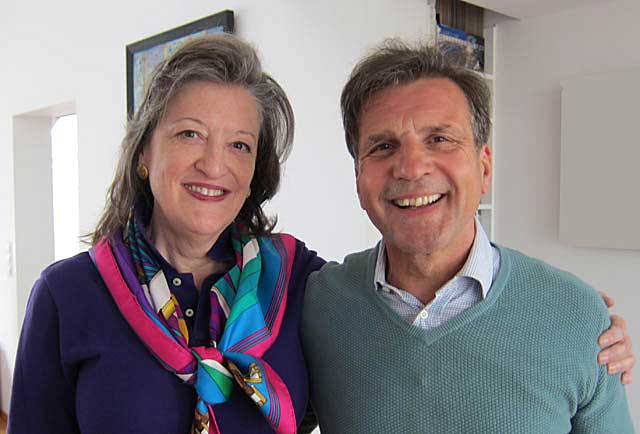
Frau Rössel's gifts to the world of music carry on in those she has taught and who have become stellar performers and teachers in their own right. For example, Wolfgang Holzmair continues to perform both Lieder and operatic roles at the pinnacle of international acclaim. He is also a Professor of Voice at the Mozarteum University in Salzburg and the former Director of its International Summer Academy. For more about Wolfgang Holzmair, visit his website.
In 2015, my husband Michael and I traveled to Vienna to celebrate the 40th anniversary of my admission to the Music Academy and enjoyed a "mini class reunion" with Wolfgang Holzmair, including a review of his collection of Frau Rössel's recordings.
I lost touch with Frau Rössel in the 1990s, to my profound regret. But she is always with me in spirit on the rare occasions when I perform. Her handiwork was evident on August 2, 1997 when I sang the National Anthem at KPMG's Family Spirit Day at the Houston Astros. My accounting firm colleagues were astonished that I "sounded like an opera singer." They might have expected something closer to the Roseanne Barr version of the Star Spangled Banner? My Rössel training didn't let me down while having the thrill of a lifetime singing for 70,000 cheering fans.
I have endeavored to emulate Frau Rössel's commitment to music education through support of various arts organizations, including serving on the boards of the Houston Grand Opera and of Mercury Baroque. In 2016, I created the Art of Business luncheon series, which has showcased musicians such as Albina Shagimuratova (coloratura soprano), Sergei Galperin (violinist), and Andrew White (pianist and chamber music impresario).
As I look back on the time I spent as Frau Rössel's student, I remain eternally grateful for her inspiration and guidance. First, there is the vocal technique that remains with me to this day, whether singing the National Anthem for a sporting event or the Bach-Gounod Ave Maria for a wedding in a 12th century French church. Twenty minutes of warm-up and I'm good to go. Second, there is the insistence on the highest standards of music performance for myself and others. Being a performer means dedication and commitment to the composer and to one's fellow performers, not just showing up and getting the notes right. The same applies to building a successful career in the business world (where the metaphor is more often a sports team but the outcome is the same!). Third, there is the self-confidence that accumulates with mastering an operatic role or a song cycle and then presenting it well to an audience. As a business person, I draw on that training every time I "perform," whether giving a speech on international business or advising a company's board on tax strategy. Fourth, there is the passion for the arts as a whole coupled with a zeal for discovery and appreciation, which I hope will never leave me. Now that I have surpassed the age Frau Rössel was when she taught me, her lessons for music and for life resound within me more fully than ever.
Frau Rössel was a great lady, a superb artist, a gifted teacher. I am privileged and grateful to have known her.
Click on the link to view and download a pdf of the booklet Goldene Kehle Goldenes Herz prepared in honor of Hilde Rössel-Majdan's 70th birthday in 1991. It includes photos from various roles as well as a complete listing of her repertoire.
Recordings (arranged by composer)
Below is a list of recordings made by Hilde Rössel-Majdan, beginning in 1949. When I first started the list as part of writing this Remembrance in 2010, I depended on what I owned (LPs and re-releases in CD form). Tracking down recordings proved challenging owing to her name appearing in different forms: Hildegaard instead of Hilde; Roessel, Roessl, and Rössl instead of Rössel. In recent years, the quest has grown easier, in light of archives being made public, the release of recordings initially broadcast on Austrian Radio or preserved by the Salzburg Festival, and databases listing LPs released in the 1950s. For what may be the most complete list of her recordings in one place (115 at last check), see Presto Music, including a growing number of re-mastered recordings to download in various formats.
Special thanks are owed to Steven Jakob, Graham Silcock, and Andy Seplow who found this web page and reached out, as well as to Wolfgang Holzmair who has been an avid collector of our teacher's recordings.
Frau Rössel made numerous monaural recordings in the early 1950s, including songs with piano accompaniment, for the American label Westminster Records. I don't recall her ever speaking about these recordings but the array is impressive, covering composers as diverse as Bach, Dvorak, Grieg, Brahms, Schubert, Wolf, and Mahler. One can listen to some of these as well as other recordings on websites such as Hoopla Digital and Archive.
Among those re-released on CD there are some gems, such as the 1958 recording of Bach's St. Matthew Passion under the direction of the Danish conductor, Mogens Wöldike. The recording of the instruments within the texture of a smaller-sized orchestra is lovely, especially the obligati accompanying arias. The drama acted out by the soloists and chorus reminds one that Bach's passions are truly operatic in nature but without staging. Although the "wobble" of excess vibrato in the chorus and in some of the other soloists can be distracting, Frau Rössel eschews such overindulgences. The lyricism and clarity of Teresa Stich-Randall in the soprano arias is a bonus. While many of the tempi seem glacial to those of us who have recorded the work under the baton of devotees of Baroque performance practice, the advantage is that one can exult, wrapped in the comforting cloak of Frau Rössel's lush contralto at this slower pace.
Daniel-Francois-Esprit Auber, Le Maçon (with Walter Anton Dotzer, Franz Fuchs, Herakles Politis, the Niederösterreicher Tonkünstler Orchestra conducted by Kurt Tener) ORF, 1950
Johann Sebastian Bach, The Passion According to Saint Matthew (with Irmgard Seefried, Julius Patzak, Otto Wiener, Hans Braun, Vienna Boys Choir, Vienna Singervein and Vienna Philharmonic conducted by Wilhelm Furtwängler) Archipel, 1952
Johann Sebastian Bach, The Passion According to Saint Matthew (with Magda Laszlo, Petre Munteanu, Hugues Cuénod, Richard Standen, Heinz Rehfuss, Eberhard Wächter, Kurt Equiluz, Vienna Academy Chamber Choir and Orchestra of the Vienna State Opera conducted by Hermann Scherchen) Westminster, 1953
Johann Sebastian Bach, The Passion According to Saint Matthew (with Teresa Stich-Randall, Waldemar Kmentt, Walter Berry, Hans Braun, Vienna Chamber Choir, Boys Choir of the Schottenstift and Vienna State Opera Orchestra conducted by Mogens Wöldike) Vanguard, 1958
Johann Sebastian Bach, The Passion According to Saint John (with Berta Seidl, Erich Majkut, Otto Wiener, Walter Berry, Austrian Chorus and Symphonic Orchestra conducted by Gottfried Preinfalk) Remington, 1951
Johann Sebastian Bach, Easter Oratorio (with Maya Weis-Osborn, Kurt Equiluz, Walter Berry, Vienna Academy Choir and Vienna Chamber Orchestra conducted by Felix Prohaska) Bach Guild, 1951
Johann Sebastian Bach, Magnificat in D and Cantata 50 (with Mimi Coertse, Margaret Sjöstedt, Anton Dermota, Frederick Guthrie, Chorus and Orchestra of the Vienna State Opera conducted by Felix Prohaska) Vanguard, 1958
Johann Sebastian Bach, Cantatas 12 and 29 (with Netania Davrath, Anton Dermota, Walter Berry, Vienna Chamber Choir and Vienna State Opera Orchestra conducted by Mogens Wöldike) Vanguard, 1960
Johann Sebastian Bach, Cantatas 53, 54, 170 (Orchestra of the Vienna State Opera conducted by Hermann Scherchen) Westminster, 1953
Johann Sebastian Bach, Cantata 76 (with Magda Laszlo, Petre Munteanu, Richard Standen, Academy Chamber Choir and Orchestra of the Vienna State Opera conducted by Hermann Scherchen) Westminster, 1957
Johann Sebastian Bach, Cantatas 76 and 84 (with Magda Laszlo, Petre Munteanu, Academy Choir and Orchestra of the Vienna State Opera conducted by Hermann Scherchen) Westminster, 1953
Johann Sebastian Bach, Cantata No. 80 (with Maya Weis-Osborn, Kurt Equiluz, Walter Berry, Vienna Academy Choir and Vienna Chamber Orchestra conducted by Felix Prohaska) Bach Guild, 1951
Johann Sebastian Bach, Cantatas No. 80 and 140 (with Anny Felbermayer, Kurt Equiluz, Walter Berry, Vienna Academy Choir and Vienna Chamber Orchestra conducted by Felix Prohaska) Bach Guild, 1951
Johann Sebastian Bach, Cantatas 84 and 106 (with Alfred Poell, Academy Chamber Choir and Orchestra of the Vienna State Opera conducted by Hermann Scherchen) Westminster, Undated
Johann Sebastian Bach, Cantatas 106 and 140 (with Alfred Poell, Academy Chamber Choir and Orchestra of the Vienna State Opera conducted by Hermann Scherchen) Westminster, 1957
Johann Sebastian Bach, Cantatas No. 161 and 202 (with Anny Felbermayer, Walter Kmentt, Chorus and Orchestra of the Bach Guild conducted by Felix Prohaska) Bach Guild, 1952
Johann Sebastian Bach, Cantata 188 (with Magda Laszlo, Alfred Poell, Waldemar Kmentt, Academy Choir and Orchestra of the Vienna State Opera conducted by Hermann Scherchen) Westminster, 1952
Johann Sebastian Bach, Cantata 198 (with Magda Laszlo, Alfred Poell, Waldemar Kmentt, Academy Choir and Orchestra of the Vienna State Opera conducted by Hermann Scherchen) Westminster, 1951
Johann Sebastian Bach, Great Arias from the Cantatas (21, 46, 63, 133, 161) (with Hugues Cuénod, unidentified orchestras conducted by Michael Gielen, Felix Prohaska, Jonathan Steinberg) Vanguard, 1953
Johann Sebastian Bach, Great Bach Singers Deutsche Grammophon, 2018
Johann Sebastian Bach, Geistliche Lieder Volume 1 (with Hugues Cuénod and Franz Holetschek, harpsichord) Westminster, Undated
Johann Sebastian Bach, Geistliche Lieder Volume 2 (with Hugues Cuénod and Franz Holetschek, harpsichord) Westminster, Undated
Johann Sebastian Bach, Geistliche Lieder Volume 3 (with Hugues Cuénod and Franz Holetschek, harpsichord) Westminster, Undated
Johann Sebastian Bach, Geistliche Lieder Volume 4 (with Hugues Cuénod and Franz Holetschek, harpsichord) Westminster, Undated
Ludwig van Beethoven, Fantasia in C Minor ('Choral Fantasy') (with Teresa Stich-Randall, Paul Schöffler, Chorus of the Vienna State Opera and Vienna Symphony Orchestra conducted by Karl Böhm) Decca, 1957
Ludwig van Beethoven, Missa Solemnis (with Teresa Stich-Randall, Hans Richter-Haaser, Paul Schöffler, Chorus of the Vienna State Opera and Vienna Symphony conducted by Karl Böhm) Decca, 1957
Ludwig van Beethoven, Missa Solemnis (with Teresa Stich-Randall, Julius Patzak, Gottlob Frick, Singverein of the Gesellschaft der Musikfreunde and Vienna Symphony conducted by Volkmar Andrae) Archipel, 1955
Ludwig van Beethoven, Symphonies 9 and 5 (with Magda Laszlo, Petre Munteanu, Richard Standen, Vienna Singakademie and Vienna State Opera Orchestra, conducted by Hermann Scherchen) Westminster, 1954
Ludwig van Beethoven, Symphony No. 9 (with Teresa Stich-Randall, Waldemar Kmentt, Gottlob Frick, Rome RAI Chorus and Turin RAI Symphony Orchestra conducted by Herbert von Karajan) 1954
Ludwig van Beethoven, Symphony No. 9 (with Teresa Stich-Randall, Anton Dermota, Paul Schöffler, Vienna Staatsoper Chorus and Vienna Symphony conducted by Karl Böhm) Fontana, 1957
Ludwig van Beethoven, The Nine Symphonies (with Gundula Janowitz, Waldemar Kmentt, Walter Berry, Vienna Singverein and Berlin Philharmonic , conducted by Herbert von Karajan) Deutsche Grammophon, 1963
Johannes Brahms, Seventeen Songs (with Erik Werba, piano) Westminster, Undated
Anton Bruckner, Te Deum (with Leontyne Price, Fritz Wunderlich, Walter Berry, Singverein of the Gesellschaft der Musikfreunden and Vienna Philharmonic conducted by Herbert von Karajan), EMI, 1960
Peter Cornelius, Der Barbier von Bagdad (with Sena Jurinac, Gottlob Frick, Alfred Poell, Chorus of the Vienna State Opera and the Vienna Radio Orchestra conducted by Heinrich Hollreiser) Preiser, Undated
Antonin Dvorak, Biblische Lieder, Zigeunerweisen, Liebeslieder (with Franz Holetschek, piano) Westminster, 1954
Antonin Dvorak, Rusalka (with Eleanor Schneider, Gerda Scheyrer, Waldemar Kmentt, Walter Berry, Vienna Radio Orchestra conducted by Felix Prohaska) 1954
Friedrich von Flotow, Highlights from 'Martha' (with Teresa Stich-Randall, Waldemar Kmentt, Walter Berry, Vienna State Opera Chorus and Vienna Symphony conducted by Franz Salmhofer) Philips, 1962
Robert Franz, Lieder (with Viktor Graef, piano) Westminster, Undated
Christoph Willibald von Gluck, Orfeo ed Euridice (with Sena Jurinac, Emmy Loose, Vienna State Opera Chorus and Austrian Radio Orchestra conducted by Michael Gielen) Walhall, 1953
Edvard Grieg, 21 Songs (with Viktor Graef, piano) Westminster, 1955
George Frideric Handel, Highlights from 'Rodelinda' (with Teresa Stich-Randall, Maureen Forrester, Alexander Young, Helen Watts, Vienna Radio Orchestra conducted by Brian Priestman) Westminster, 1964
Franz Josef Haydn, Mass in Time of War (with Netania Davrath, Anton Dermota, Walter Berry, Chorus and Orchestra of the Vienna State Opera, conducted by Mogens Wöldike) The Bach Guild, 1960
Leos Janacek, Glagolitic Mass (with Evelyn Lear, Ernst Haefliger, Franz Crass, Chorus and Orchestra of the Bavarian Radio conducted by Rafael Kubelik) Deutsche Grammophon, 1965
Albert Lortzing, Der Wildschütz (with Irmgard Seefried, Anny Felbermayer, Renate Holm, Waldemar Kmentt, Karl Dönsch, Georg Völker, Chorus and Orchestra of the Vienna State Opera conducted by Heinz Wallberg), Orfeo, 1955
Gustav Mahler, Symphony No. 2 in C Minor ('Resurrection') (with Ilona Steingruber, Academy Chamber Choir, Vienna Singverein, and Vienna Symphony conducted by Otto Klemperer) Vox, 1951
Gustav Mahler, Symphony No. 2 in C Minor ('Resurrection') (with Galina Vishnevskaya, Vienna Philharmonic conducted by Otto Klemperer) Music & Arts, 1963
Gustav Mahler, Symphony No. 2 in C Minor ('Resurrection') (with Elisabeth Schwarzkopf, Philharmonia Chorus and Orchestra conducted by Otto Klemperer) EMI, 1963
Gustav Mahler, Symphony No. 3 in D Minor (Vienna State Opera Orchestra conducted by Hermann Scherchen) Westminster, 1951
Gustav Mahler, Symphony No. 3 in D Minor (Vienna Boys Choir, Vienna State Opera Chorus and Vienna Symphony conducted by F. Charles Adler) SPA, 1953
Gustav Mahler, Symphony No. 8 in E-flat Major (with Melitta Muszely, Gerda Scheyrer, Wilma Lipp, Ursula Boese, Fritz Wunderlich, Hermann Prey, Otto Edelmann, Singverein of the Gesellschaft der Musikfreunde and Vienna Symphony conducted by Joseph Keilberth), St. Laurent Studio, 1960
Gustav Mahler, Kindertotenlieder (Vienna Symphony conducted by Heinz Wallberg) Atlas, released 1990
Gustav Mahler, Das Lied von der Erde (with Waldemar Kmentt, Vienna Philharmonic conducted by Raphael Kubelik) Orfeo, 1959
Claudio Monteverdi, L'Incoronazione di Poppea (with Sena Jurinac, Gundula Janowitz, Gerhard Stolze, Vienna State Opera Orchestra conducted by Herbert von Karajan) Deutsche Grammophon, 1960
Wolfgang Amadeus Mozart, Die Zauberflöte (with Hilde Güden, Leopold Simoneau, Wilma Lipp, Kurt Böhme, Emmy Loose, August Jaresch, Paul Schöffler, Judith Hellwig, Christa Ludwig, Chorus and Orchestra of the Vienna State Opera conducted by Karl Böhm) Decca, 1955
Wolfgang Amadeus Mozart, Die Zauberflöte (with Nicolai Gedda, Wilma Lipp, Ingeborg Hallstein, Gottlob Frick, Eberhard Wächter, Gerda Scheyrer, Grace Hoffman, Chorus and Orchestra of the Vienna State Opera conducted by Herbert von Karajan) Urania, 1962
Wolfgang Amadeus Mozart, Le Nozze di Figaro (with Cesare Siepi, Hilde Gueden, Alfred Poell, Lisa della Casa, Suzanne Danco, Fernando Corena, Murray Dickie, Chorus and Orchestra of the Vienna State Opera conducted by Erich Kleiber) Decca, 1955
Wolfgang Amadeus Mozart, Coronation Mass (with Edith Gabry, Waldemar Kmentt, Otto Wiener, Chorus of the Gesellschaft der Musikfreunde and Vienna Symphony conducted by Istvan Kertesz) Oriole, 1963
Wolfgang Amadeus Mozart, Mass in C Minor KV 427 (with Theresa Stich-Randall, Waldemar Kmentt, Vienna Chamber Chorus and Vienna Symphony conducted by Rudolf Moralt) Phillips, 1962
Wolfgang Amadeus Mozart, Requiem in D Minor KV 626 (with Magda Laszlo, Petre Munteanu, Richard Standen, Academy Chamber Choir and Orchestra of the Vienna State Opera conducted by Hermann Scherchen) Westminster, 1953
Wolfgang Amadeus Mozart, Requiem in D Minor KV 626 (with Irmgard Seefried, Anton Dermota, Gottlob Frick, the Vienna State Opera Chorus and the Vienna Philharmonic conducted by Karl Böhm) Orfeo, 1955
Wolfgang Amadeus Mozart, Requiem in D Minor KV 626 (with Wilma Lipp, Anton Dermota, Otto Edelmann, Vienna Singverein and Vienna Philharmonic conducted by Bruno Walter) 1956 radio broadcast released by Sony in 1975
Wolfgang Amadeus Mozart, Requiem in D Minor KV 626 (with Leontyne Price, Fritz Wunderlich, Walter Berry, Vienna Singverein and Vienna Philharmonic conducted by Herbert von Karajan) Archipel, 1960
Wolfgang Amadeus Mozart, Requiem in D Minor KV 626 (with Wilma Lipp, Anton Dermota, Walter Berry, Vienna Singverein and Berlin Philharmonic conducted by Herbert von Karajan) Deutsche Grammophon, 1962
Otto Nicolai, The Merry Wives of Windsor (with Mimi Coertse, Waldemar Kmentt, Gottlob Frick, Chorus and Orchestra of the Vienna Radio conducted by Kurt Richter) Walhall, 1958
Hans Pfitzner, Palestrina (with Sena Jurinac, Christa Ludwig, Fritz Wunderlich, Gottlob Frick, Walter Berry, Austrian Radio Orchestra conducted by Hans Hotter) 1964
Giacomo Puccini, Madama Butterfly (with Daniza Illitsch, Ratko Delorco, August Jaresch, Jovan Gligor, Emil Siegerth, Aenne Michalsky, Austrian Symphony Orchestra And Choir conducted by Wilhelm Loibner) 1952
Giacomo Puccini, Madama Butterfly (with Sena Jurinac, Ermanno Lorenzi, Kostas Paskalis, Chorus and Orchestra of the Vienna State Opera conducted by Berislav Klobucar) Myto, 1961
Giacomo Puccini, Suor Angelica (with Sena Jurinac, Ilona Steingruber, Vienna Philharmonic conducted by Wilhelm Loibner) 1951
Hermann Reutter, Die Brücke Von San Luis Ray (with Gerda Scheyrer, Waldemar Kmentt, Walter Berry, Orchestra of the Austrian Radio conducted by Michael Gielen) Walhall, 1955
Franz Schubert, The Complete Music to 'Rosamunde' (with the Academy Choir and Orchestra of the Vienna State Opera conducted by Dean Dixon) Westminster, 1953
Johann Strauss, Jr. Der Zigeunerbaron (with Gerda Scheyrer, Emmy Loose, Waldemar Kmentt, Erich Kunz, Eberhard Wächter, Chorus and Orchestra of the Vienna Volksoper conducted by Anton Paulik) Vanguard, 1956
Richard Strauss, Ariadne auf Naxos (with Lisa della Casa, Irmgard Seefried, Hilde Güden, Walter Berry, Vienna Philharmonic conducted by Karl Böhm) Salzburg Festival, 1954
Richard Strauss, Die Frau Ohne Schatten (with Leonie Rysanek, Elisabeth Höngen, Christel Goltz, Ludwig Weber, Vienna State Opera Chorus and Orchestra conducted by Karl Böhm) Orfeo, Undated
Richard Strauss, Der Rosenkavalier (with Maria Reining, Ludwig Weber, Sena Jurinac, Alfred Poell, Hilde Güden, Anton Dermota, Chorus of the Vienna State Opera and Vienna Philharmonic conducted by Erich Kleiber) London, 1954
Richard Strauss, Der Rosenkavalier (with Anneliese Rothenberger, Alois Pernerstorfer, Otto Edelmann, Sena Jurinac, Elisabeth Schwarzkopf, Erich Kunz, Chorus of the Vienna State Opera and Vienna Philharmonic conducted by Herbert von Karajan) Live television broadcast from the Salzburg Festival, 1957 (subsequently released on video and available from a number of vendors)
Richard Strauss, Der Rosenkavalier (with Hilde Zadek, Sena Jurinac, Teresa Stich-Randall, Ludwig Weber, Coro della RAI di Torino, Orchestra Sinfonica Nazionale della RAI di Torino conducted by Artur Rodzinski) Myto, 2008 (original recording 1957)
Pyotr Tchaikovsky, Eugen Onegin (with Leonie Rysanek, Anton Dermota, George London, Chorus and Orchestra of the Vienna State Opera conducted by Berislav Klobucar) Andromeda, 1955
Giuseppe Verdi, Falstaff (with Dietrich Fischer-Dieskau, Regina Resnik, Vienna Philharmonic conducted by Leonard Bernstein) Columbia, 1969
Richard Wagner, Die Walküre (with Birgit Nilsson, Leonie Rysanek, Hans Hotter, Christa Ludwig, Chorus and Orchestra of La Scala conducted by Herbert von Karajan) IDIS, 1958
Richard Wagner, Der Ring des Nibelungen - 'Das Rheingold' and 'Götterdämmerung' (with Sena Jurinac, Rita Streich, Martha Mödl, Josef Greindl, Orchestra Sinfonica della Radio Italiana conducted by Wilhelm Furtwängler) EMI, 1953
Richard Wagner, Der Ring des Nibelungen (with Sena Jurinac, Leonie Rysanek, Rita Streich, Theo Adam, Anton Dermota, Josef Greindl, Orchestra of the Bayreuth Festival conducted by Karl Böhm) Decca, 1966
Richard Wagner, Parsifal (with Eberhard Wächter, Hans Hotter, Fritz Uhl, conducted by Herbert von Karajan) Opera D'Oro, 1961
Richard Wagner, Rienzi (with Günther Treptow, Gerda Scheyrer, Adolf Vogel, Waldemar Kmentt, and Walter Berry, conducted by Robert Heger) Walhall, 2008
Richard Wagner, Tristan und Isolde (with Birgit Nilsson, Hans Hotter, Gustav Neidlinger, Claude Heater, Anton Dermota, Chorus and Orchestra of La Scala conducted by Herbert von Karajan) Archipel, 1959
Carl Maria von Weber, Euryanthe (with Maria Reining, Walter Berry, Friedl Riegler, Chorus and Orchestra of the Austrian Radio conducted by Meinhard von Zallinger) Melodram, 1949
Carl Maria von Weber, Euryanthe (excerpt conducted by Meinhard von Zallinger) Die Sänger der Wiener Staatsoper zur Wiedereröffnung des Hauses am Ring 1955 (The Singers of the Vienna State Opera upon the Re-Opening of the House on the Ring 1955), Preiser Records, 2005
Hugo Wolf, Roessel-Majdan Sings Hugo Wolf (with Erik Werba, piano) Westminster, Undated