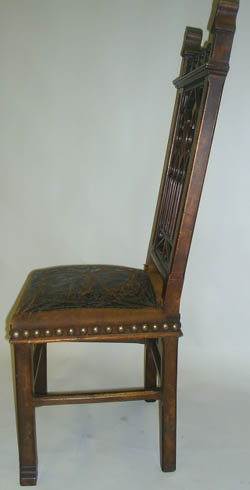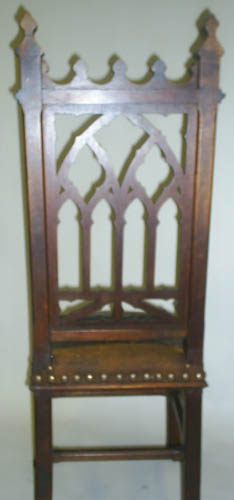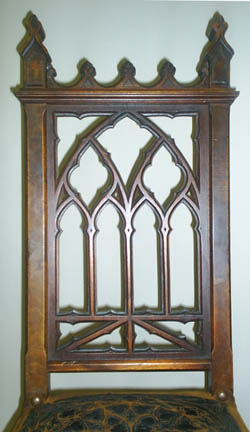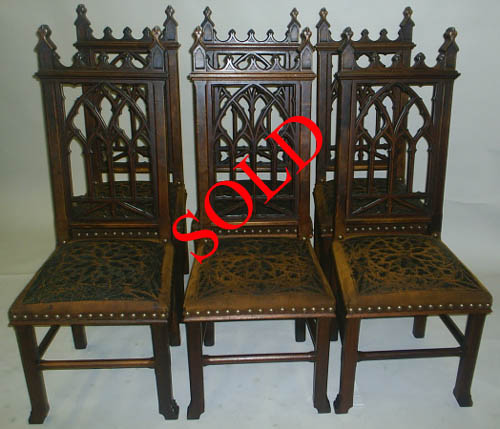
We like to say that we sell unique items, but these dining chairs reflect the pinnacle of French Gothic Revival in its purest state. They elevate open fenestrage or tracery to the highest levels of refinement and sophistication in chairs that are comfortable and sturdy. Made of magnificently hand-carved walnut, with seats of embossed leather in a rose window design, they are almost too beautiful to sit on!
The backs of the chairs are rectangular, framing a tall, Gothic, pointed arch - not the S-curve or ogee of late Gothic or flamboyant style, but the simpler version used to perfection in Chartres Cathedral and its less-renowned but magnificent contemporary, the parish church of Saint Nicolas in Blois (a favorite of ours, that just doesn't get enough attention since it is not a cathedral). Mimicking the stone tracery outlining windows of Gothic buildings, the design of the backs of these chairs involves arches within arches, specifically a pair of arches further subdivided by lancet arches, the tall slim arch with cusps near the top. Keeping the Gothic vocabulary simple, the spaces within the arches are not filled with flowers or foils (the leaf or feuille of a clover with anywhere from three to five leaves) but rather with open-work in the form of simple soufflets and spandrels.
The base of the main arch is made up of a rectangular space divided into four right triangles, two of which form a central isosceles triangle. All the geometry involved in the central design of arches and triangles reflects the challenges and skills at work in designing buildings such as Chartres Cathedral where design and construction were based on units and motifs recurring consistently - a hierarchy of subdivision partitioning space.
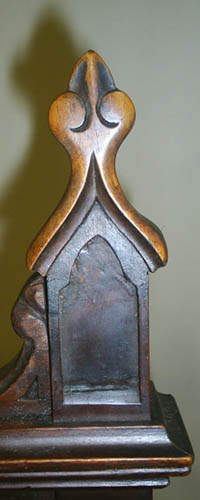
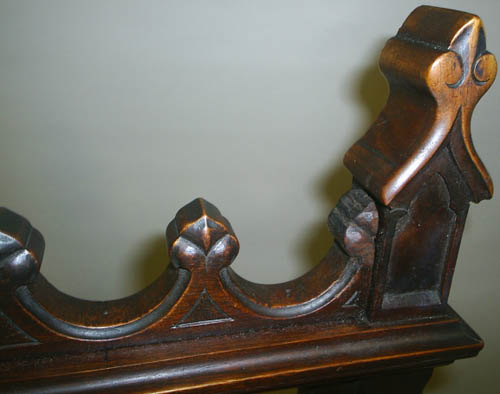
The tops of the backs of the chairs consist of a frieze with a finial at each end in the form of a stylized fleur-de-lys at the top, above a base carved in the form of a Gothic niche. The frieze has its origins in medieval seating, especially bishops' thrones (chaises cathèdres) whose tall backs were topped by alternating semi-circles and finials, called choux frisés (for their resemblance to a kale leaf!). Here, they mimicking the stylized fleurs-de-lys crowning each side of the chair backs.
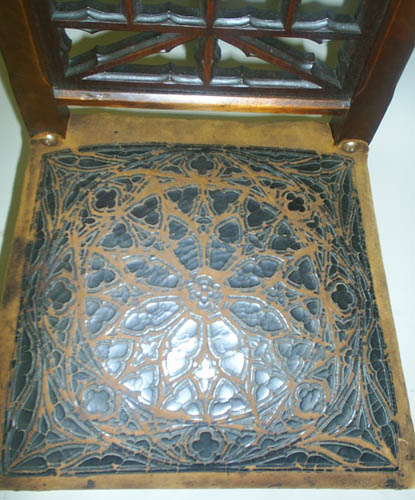
The seats of these chairs are like nothing we have seen before. Sueded leather panels embossed with the pattern of a rosace or rose window cover the seats and are anchored by large, decorative nails. The petals of the central, circular design resemble a daisy more than a rose, but we understand that this was not uncommon in stained glass windows either. The circular design within a trapezoidal framework is a masterpiece of Gothic ingenuity. In between the petals are soufflets mirroring those in the chair backs and both trefoils and quatrefoils, a variation on the cloverleaf shape.
To say that it is a miracle that the leather on these chairs has survived all these years is an understatement. We never expected to be able to preserve it but, owing to the apparent lack of wear, we were able to restore the original softness and suppleness of the leather and to assure comfortable seating for years to come by changing out the springs and padding. In restoring the leather, we relied on advice and products from Preservation Solutions, LLC, whose formulations are used by museums in conserving such leather items as saddles and bindings on books.
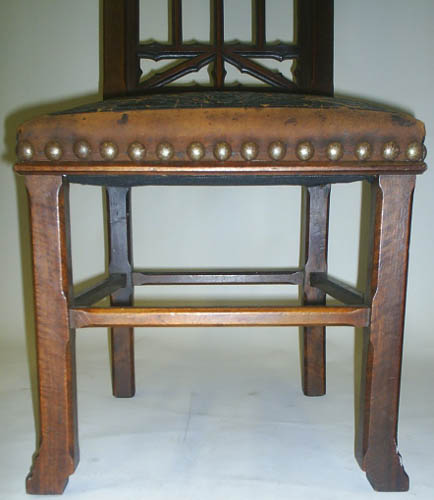
In keeping with French tradition, the reverse sides of these chairs are completely unadorned, the expectation being that when not in use they would be backed up against a wall. Similarly, the bases of the chairs are a standard, trapezoidal framework with stretchers around the perimeter, but lacking in ornamentation. Sturdy and showing the magnificence of the walnut to perfection, it is evident that the artist expected the focus to be on the magnificent carving of the backs and on the leather seats.
Reference
Charles, Corinne, Visions d'Intérieurs, du Meuble au Décor (Paris-Musées, Paris, 2003); Thirion, Jacques, Le Mobilier du Moyen Age et de la Renaissance en France (Editions Faton, Dijon, 1998); Viollet-le-Duc, Eugène, Le Mobilier Médiéval (Georges Bernage, editor) (Editions Heimdal, 2003)
Uses
These chairs are suited do a dining room, preferably with a Gothic table such as 4110 (the one they were originally paired with) or another from our collection.