When you have been in the antiques business as long as we have, and seen pieces whose structure, refinement, inventiveness, charm, and utter virtuosity of execution can take your breath away, it is easy to conclude that no more pieces like that will ever come onto the market. So, imagine our surprise and delight when, walking through the cavernous warehouse of one of our partenaires in Europe whose stock is 99% something other than Gothic, this magnificent cabinet jarred us out of our complacency.
Struck first by the birds at the pinnacle and then by the phantasmagoric figures outlining the mirror and the endearing figures leaning from mock windows along the top, there was no curbing our enthusiasm. Years of ingrained reticence and never letting on to a dealer that we really, really wanted something, all went out the window as we enthused and exclaimed over each remarkable detail of this stunning piece. So it is that we offer it, a bit reluctantly, for sale. But with the expectation that it will go to a good home and be cherished for generations to come.
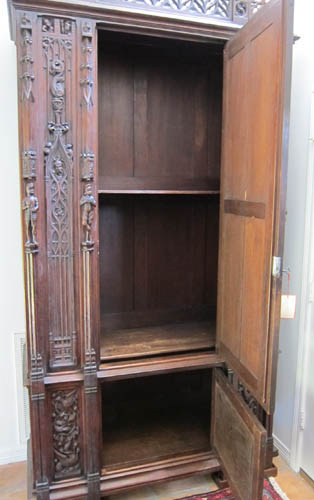
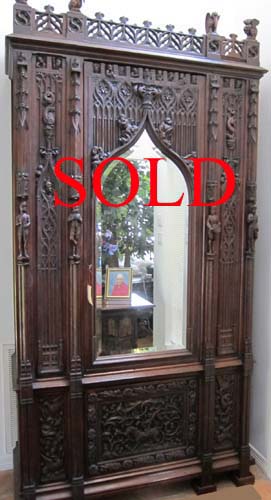
In overall structure, this cabinet might also be considered an armoire, but we think its original purpose was as a cabinet with pride of place in a special home or perhaps a castle. An upper part is comprised of a door whose main panel is in the shape of an ogee arch, the graceful "S" curve shape that characterized the High Gothic.
In keeping with the flamboyant style at the tail-end of the Middle Ages, the curved arch tapers not to a point but continues up into a flame or flambe from which the style earned its name. Like so many French pieces in the 19th century revival of the Flamboyant Gothic Style, this flame is a stylized fleur-de-lys or iris flower affording the sculptor ample opportunity to display his talents. In a nod to the flame aspect of flamboyant, the flower sits atop the base of a torch. The flower's foliage morphs into acanthus leaves whose delicate curves are echoed in other aspects of the cabinet such as the winged figures on either side, near the top of the mirror.
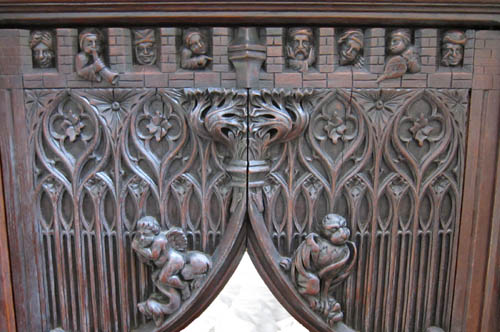
We note that there is a split running through the center of the flamboyant top to the arch, clearly visible in the photo below. To preserve the integrity of the cabinet as an antique, we have not repaired it nor does it impair use of the door.
While photos give some sense of the virtuosity of the carving and the refinement of details rendered in a wood as hard as oak, there is no substitute for admiring all this in person and marveling at the talent and accomplishment of the nameless artists who expressed themselves so eloquently. Nevertheless, we will try to describe some of the aspects that have left us awestruck.
The mirror is clearly the center of the cabinet, drawing the eye to one's reflection and then outward to the figures surrounding it and the architectural elements framing it. For the door panel, the theme is more ogees and tracery (or fenestrage) — four large arches subdivided into ever smaller ones, to the point of slim lancet arches filled with soufflets, quatrefoils and stylized flowers. Indeed, this central door becomes the entryway into the fantastic world inhabited by birds, knights, serpents, fish, griffins, panthers, and an array of what could be gossipy neighbors atop the parapets of a city wall.
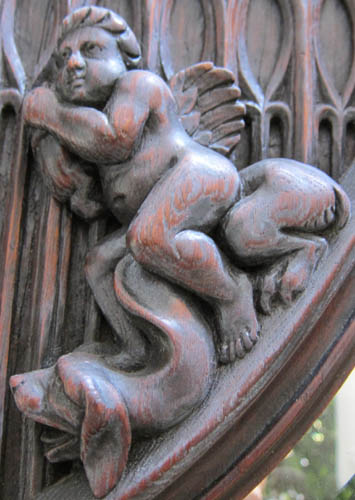
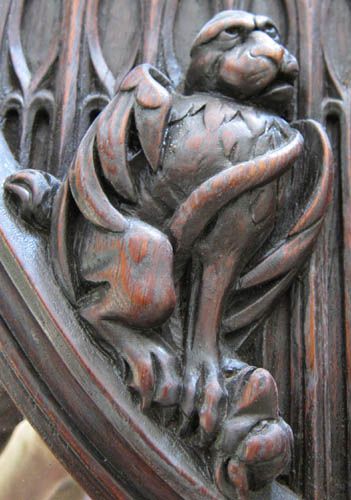
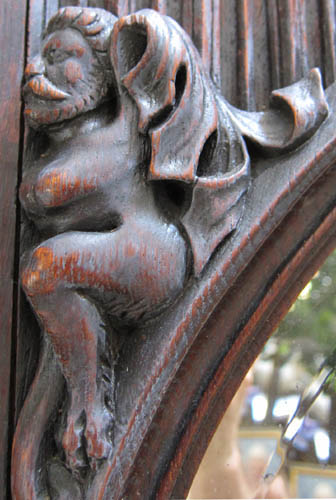
Along the curved part of the mirror's frame are four figures, two on each side, in place of the crockets or stylized foliage one might otherwise expect to see on a Gothic arch. Combining elements from various members of the animal kingdom, these figures include, on the left side, a putto atop a crouching dog. Farther down on the left side is another winged creature but this time much older, sporting a mustache and beard, as well as claws and a tail. On the right side is an eagle, but with the face of a dog.
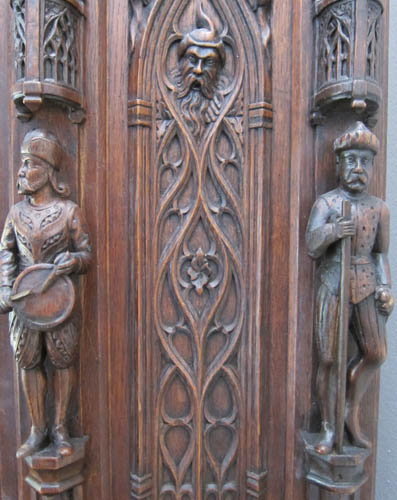
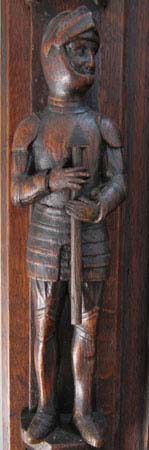
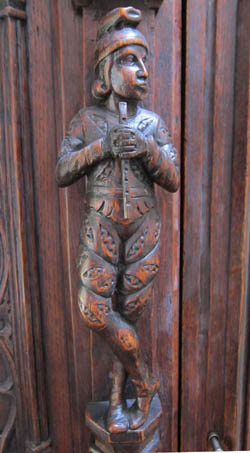
Borrowing from the architectural traditions of the great Gothic cathedrals whose western doors were framed by tall statutes of saints on pedestals and in niches capped by canopies, the central part of the cabinet has four figures, each represented by a different costume. On the far left is a knight in full armor, holding a lance, the visor of his helmet raised to reveal the delicate carving of facial features. The hand holding the lance has been repaired. Next, closer to the mirror, is a figure in an intricately patterned costume and floppy hat holding a flute, and reminding us of Papageno (from Mozart's The Magic Flute) in his nonchalant pose and the impish tilt of his head as he looks off to his left.
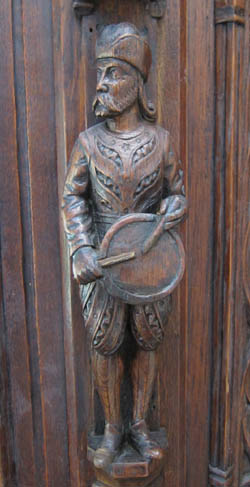
On the right of the mirror is another musical figure in similarly patterned garb, this time playing a drum and gazing off to his right. This figure is especially remarkable for the detailed carving of the hair, beard, and mustache (like the figure framing the mirror and perhaps a likeness of the artist?).
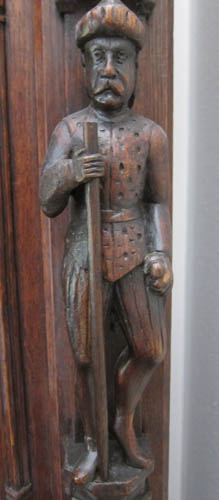
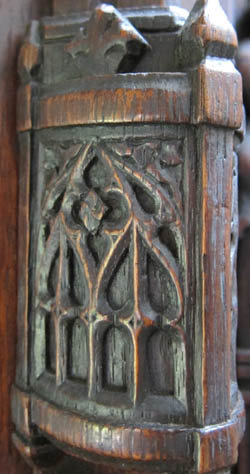
The figure at the far right is a bit more of a puzzle. Holding a long stick and a ball in his left hand, he is either another chivalric figure or an avid sportsman. Just above each of these figures are wonderfully carved Gothic canopies comprised of arches, quatrefoils, and soufflets topped by fleurs-de-lys.
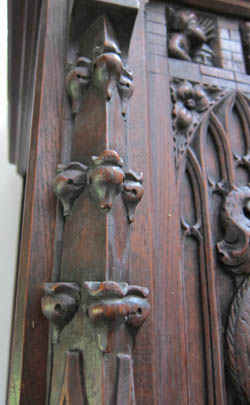
Above and below the figures are columns topped by crocketed finials in the flamboyant style.
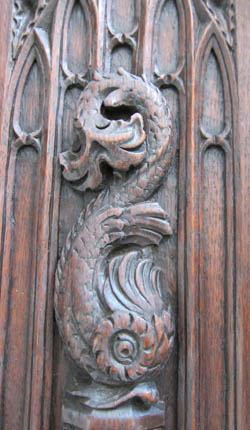
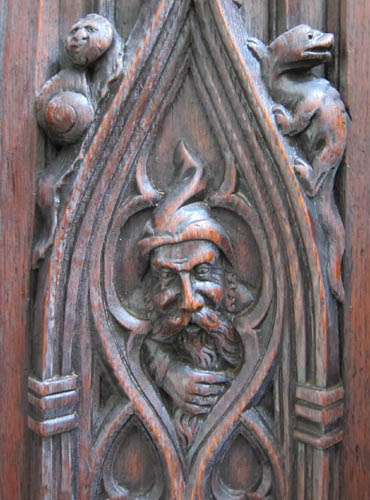
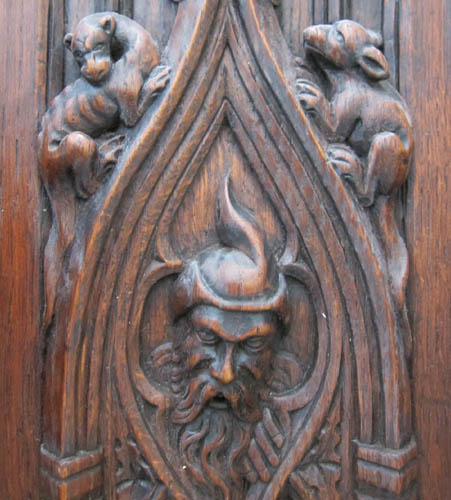
Between the panels containing the figures, on both sides of the mirror, are tall ogee arches whose decoration is unique and demonstrates the inventiveness of the designer along with a thorough knowledge of Gothic style, decoration, and a penchant for fantasy. The soufflet on the left is treated as a window, a figure within it grasping his long beard. On either side of the arch just above his head are a snail with the head of a monkey and a serpent with the head of a fish. Atop the flamboyant arch is an elongated dolphin. On the other side of the mirror is a similar arch and soufflet, but with the figure's hand on the edge of the window. On either side of that arch are a panther with webbed feet and a rat with giant claws.
Atop the flamboyant arch is an elongated salamander.
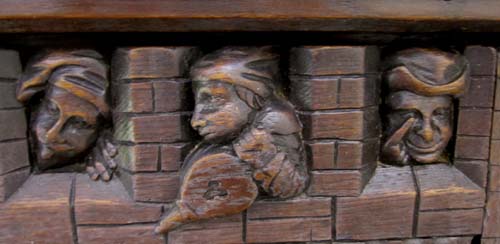
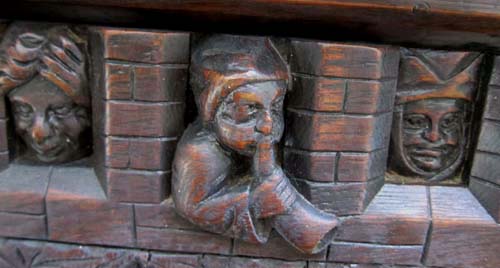
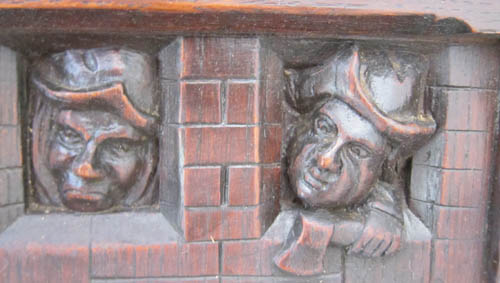
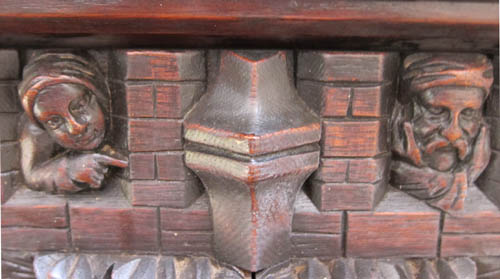
Just below the top of the cabinet is a series of openings, as in a city wall or tower, with tiny heads leaning out and hands holding everything from a bellows to a hatchet. One figure is blowing a horn, and several are gesturing. It is tempting to contemplate what they symbolize.
Judging by the less refined nature of the carving and the more mundane nature of the acts in which they are engaged, it is unlikely that they represent the owner's family unless he meant it as a joke.
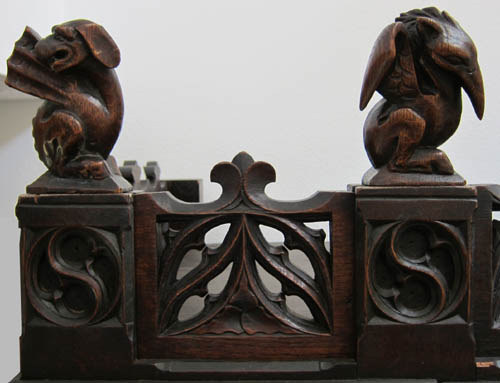
At the very top of the cabinet is a series of open tracery or fenestrage panels, each of which is crowned by a fleur-de-lys.
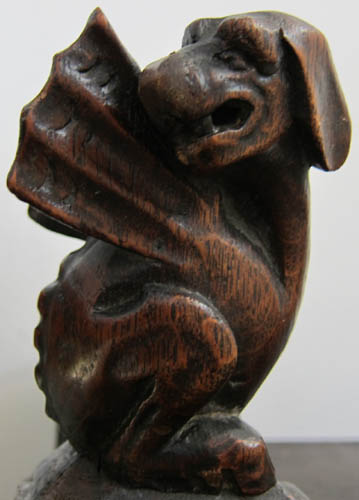
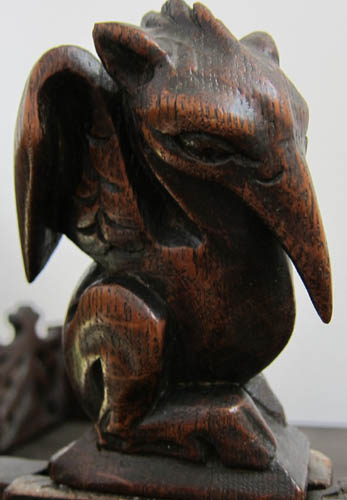
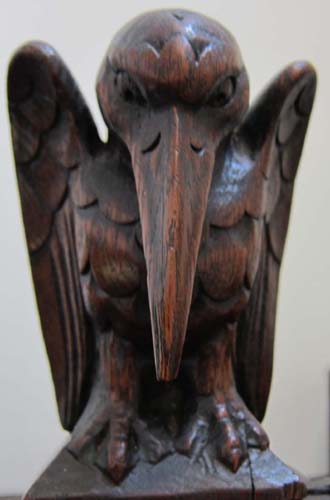
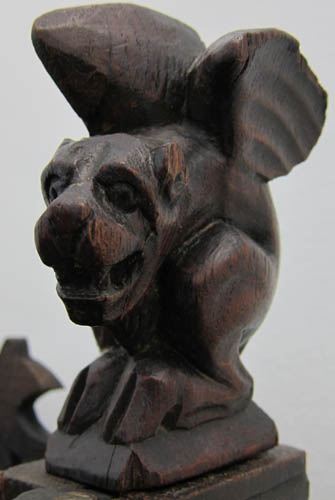
Four free-standing figures, more like grotesques (gargoyles or animal figures that do not function as water spouts), crown this cabinet with a final, fantasy statement. At each corner is a winged creature. On the left corner is a dog sitting on its haunches and looking over its right shoulder. On the right corner is a crouched griffin, mouth open, seemingly ready to pounce. On the front at the left is a bird whose species we have yet to identify. On the right is another bird, possibly a stork, intricately carved and with a long beak and a steady gaze, searching out its prey. It reminds us of the corson grotesque on Notre Dame de Paris.
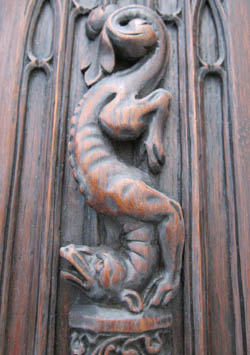
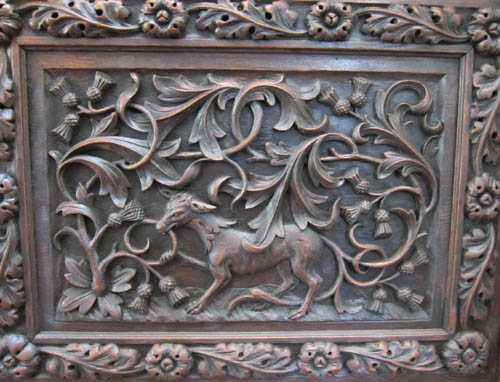
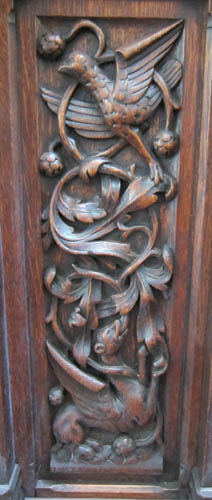
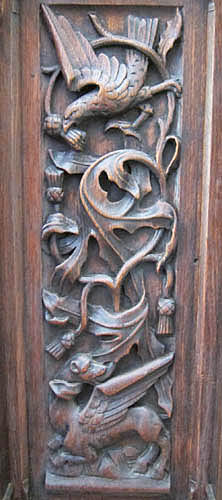
Of a distinct style is the lower part of the cabinet comprised of a central door and panels on either side. Here the style of carving is more fluid and reminiscent of the curved line and intertwining vegetation seen in the decoration of Roman sarcophagi. In the center of the door is a creature, seemingly part horse part goat, with a tail that branches out to comprise most of the stems, leaves, and thistles that make up the decorative theme of this central panel and the ones on either side as well. Those, however, have intricately carved birds at the top and griffins at the bottom.
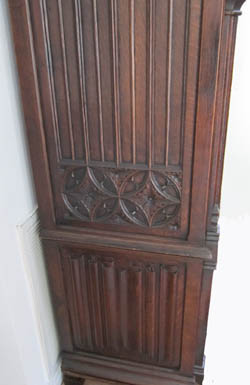
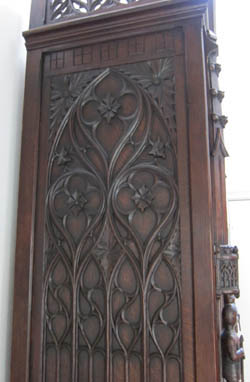
The sides of the cabinet are also remarkable, in terms of the lavish decoration. Instead of leaving the panels plain, or simply repeating the plis-de-serviette pattern used at the base, the upper 2/3 of the side is made up of yet another example of elaborate fenestrage or tracery with arches, inside arches, inside more arches and graceful quatrefoils and mouchettes filling the voids.
As anyone who has read the narrative to this point will recognize, it is hard not to get carried away in the sheer delight that comes from viewing this cabinet. We hope that the photos, below, will help tell the story of this remarkable piece of the French cabinet-maker's art.
Reference
Ader-Tajan, Collection Bruno Perrier Haute Epoque (Catalog for Sale at Auction on April 6, 1992 at the Hôtel Drouot, Paris); Boccador, Jacqueline, Le Mobilier Français du Moyen Age à la Renaissance (Editions d'Art Monelle Hayot, Saint-Just-en-Chaussée, 1988); Thirion, Jacques, Le Mobilier du Moyen Age et de la Renaissance en France (Editions Faton, Dijon, 1998); Viollet-le-Duc, Eugène, Le Mobilier Médiéval (Georges Bernage, editor) (Editions Heimdal, 2003)
Uses
This cabinet is meant to be the center of attention, preferably with specialty lighting, so its magnificence and the intricacy of its details can be admired most fully.